Tuesday, August 7, 2007

Titanic Discovered

On 1985, July 14th, the Titanic was discovered! It was the first time the great ship had been seen for more than 70 years. A French and American research team joined up with Bob Ballard to search for and find the Titanic.
Once again, the ship caught the world’s attention. At the American inquires, not much could be reported because the ship was gone there was no hard fact evidence. But now that the ship was rediscovered, it raised new questions and gave new answers! For the first time, it was verified that the ship did break in two. Why did the steel plates snap apart? Why were they speeding through a known ice field? Why? Why? Why? As a result of finding the Titanic, many of these questions could be answered.
The Titanic broke in two because of the angle it was at and the pressure it put on the lower part of the ship! Also, in 1912, they were not concerned about the grade of steel used, and tests of the Titanic’s steel proved it was of a poor grade. If steel will bend and move to pressure it is of a higher grade, if under pressure poorly graded steel will snap, and will become brittle in cold water. This is also the reason the rivets popped out of their seams, the steel was pushed apart by great pressure, and not ripped apart like many think.
Why didn’t the watertight compartments work? Because they only went up to E deck, one more deck higher [to boat deck] and the ship would have been completely sealed off. A vital flaw in the design! It worked like this, if any four or five of her compartments were flooded, the weight of the water would not pull her down far enough to spill over into the next compartment. None could think of a wreck of such magnitude that more than five of her compartments would be punctured. But alas, six compartments were damaged the night of April 14th. The weight of the water pulled the bow down into the ocean, thus having an ice-cube tray effect, it just spilled over into the next compartment and into the next until it sank. So, which means that they were not really watertight like the owners and builders said, there was a gap at the top of each bulkhead allowing water to spill over. That is not watertight.
They were speeding through a known ice field because J. Bruce Ismay want to surprise everyone and get to New York, a day early He wanted to beat the Olympic’s record crossing the Atlantic.
These are just a few of the things the world wanted to know.
Since 1986, many, dives have been made to the Titanic, gathering information, finding new things, and exploring the unknown parts of the ship.
James Cameron, the movie director of the film Titanic, has spent more time with the ship underwater than the passengers that sailed on her. One couple was even married over the stern of the Titanic! Anyone can go down to the wreck, for the small amount of $38,000.
One thing that will go down in the history of the Titanic is the abounding bravery of the men aboard the Titanic. They will be forever being remembered as men who were willing to make the ultimate sacrifice for the women and children. Think about if the men had no restraint, there probably would have been no surviving women and definitely no surviving children. The Titanic would be a different story. They deserve more honors, and respect than they get.
What if a situation arose today, where it was women and children, or the men first?
Think about the Titanic’s band, they showed more bravery than some men show on the battlefield. Playing to the very last instead of trying to save themselves, their song must have drifted out on the waves into the ears of the few who got in a lifeboat. White Star Line charged the family members of the ship’s band for the loss of their uniforms!
What about John Bruce Ismay? That cowardly man was rejected by the world and died lonely and poor, his life was ruined when he stepped into the lifeboat. Was it really worth it?
What about the Californian? Sitting all night through the disaster? Her Captain was charged with failure to render aid to a ship in distress. As a result of his decisions, he lost his job and was looked at very poorly by the world. If he would have used common sense he could have saved almost everyone on board!!!
Many people took their lives. The lookout in the crow’s nest, Fredrick Fleet, who called the bridge and said those fateful words……… “iceberg dead ahead”, killed himself 5 years after the disaster, he, also was not able to live with himself. As we know, First Officer Murdoch took his life on the ship, he also could not live with the regret. Jack B. Thayer had haunting thoughts of the disaster till he was 52 and took his own life.
A lot is said about the bravery of the Captain and Officers, but little is said about the bravery of the men below decks. It was said that 17 engine men got down on their knees in the engine room and prayed until water surged up to their necks, then they stood up, clasped hands formed a circle and died there in the belly of the ship, staying at their posts till death took them in its cold embrace. Southampton alone lost 500 men on the Titanic, all stokers or trimmers, men who stayed at their posts and died just as gloriously as the brave men on the top of the ship.
Many movies have been made about the great ship Titanic. But none can ever compare to the real thing, or how people felt.
People have been down to the wreck numerous times to bring back artifacts, some say that should not be done. I am not against bringing up different items. Why let it all turn to rust? I’m not for trying to make a profit off of it. It should be strictly used for museum purposes. It should be used as a learning experience.
Some have talked and thought to bring the Titanic up out of the depths. That’s going too far! It’s impossible to “raise the Titanic.” When she sped down through the depths, she hit the bottom at a great speed; the bow sliced through the mud and is buried in 60 feet of mud. The stern plunged with huge air pockets inside, and when it hit the ocean floor the air burst through the steel and it crumpled and fell apart. So, in order to raise the Titanic’s bow, you would be trying to lift over 33,000 tons of rusted steel out of 60 feet of mud, and where the pressure per square inch is 6,000 pounds! And even if you were able to get a grip of it, it would probably crumple in its weakened state. The stern would be completely impossible to raise, all it is, is twisted and crumpled steel. It is a graveyard, many brave men were killed there and to go and cause that much disruption would be disregarding death, and for that reason alone we ought to have respect for it.

I have found an interesting point of view of the Titanic, what if the Titanic had never met disaster?
If the Titanic would-not-have sunk she would have arrived in New York, Tuesday, sometime before schedule, and it would have been a glorious arrival. She would have been a complete success! She would of served the White Star Line for many years. But later, she probably would have met the fate that her sister ships met. In World War1, the Britannic and the Olympic were turned into hospital ships. The Britannic met her fate by hitting a mine and sank in 45 minutes most of the soldiers were saved. Olympic served throughout the war and received many battle scars. After the war she was used again as a trans-Atlantic liner. In the early 1930s she was sold for scrap. Titanic would have probably have met a fate similar to this.
If the Titanic would have hit the iceberg head on, she would have survived, and been towed to Halifax for repairs. But sadly enough none of this happened! If just a few times, sense had been used, the Titanic disaster would have not happened.

Over the course of five years in the making all the planning, new slipways, work, fitting out, excitement, the largest most elegant ship sank in less than three hours! Many stories go along with the Titanic, some are sad some are stories of bravery and manhood, yet some are stories of cowards and treachery, and then there are stories of pride and arrogance.
Many things about the Titanic cannot be put on paper; it must be the legacy that the ship left. But many things can be learned from the disaster.
The story of the Titanic will go on forever.

____________________________________________________________________

The sinking of the Titanic has been a magnet to underwater ship-explorers. Even in 1912, after the Titanic sank, there was talk of trying to find her. They soon found out they really didn’t know where she was when she sank, nor how deep it was where she hit bottom.
But as the years went on, so did technology towards underwater exploration. Many different groups of people set out to find the great wreck, but all still came back empty-handed.
Not until July of 1985 did the American and French research team find the wreck. Once again the Titanic made world news, and once again she was in the spotlight. Now that the ship was found, it raised possibilities of going down in a small submarine that could withstand the deep-sea pressure. Exactly one year later, Bob Ballard and two other undersea explorers went, for the first time, down to the wreck. There was doubt in the minds of those going down to the wreck; they still didn’t know that the ship had broken in two. They didn’t know what to expect, what if all the rigging was intact, that would create a great hazard to maneuvering about the ship. Would the Titanic even be recognizable? Or would she be sitting perfect on the ocean floor? As Bob Ballard and the other researchers reached the ocean floor, they tried to locate the Titanic. The submersible they were using, the Alvin, sprang a leak in her batteries. Now they only had a couple of minutes on the ocean bed and they had not seen the Titanic. Peering through the small portholes of the Alvin, a massive wall of black steel loomed up right in front of them, that was the only glimpse of the ship they got that time. The leak in the batteries would become critical if they didn’t surface.
Since that July in 1986, numerous dives have been made to the Titanic. Several people have spent more time with the Titanic underwater, than the Captain spent with her on the seas.
One thing is certain; the Titanic is in a state of complete devastation. The ship broke in two in between the third and fourth funnels; and all of those funnels are gone. In one square mile there are boilers, teacups, beds, tables, engines, wine bottles, suitcases, chairs, and the list could go on.
The beauty of the ship is now gone, her once proud hull glimmering in the bright sunlight, now is encrusted in rusting steel. Where her four behemoth funnels stood are now just gaping holes on top of the ship. Her once proud stern, the beauty of the ship, where at the end of Titanic’s short life, men and women alike met their fate, now lays almost unrecognizable due too the impact that she suffered when she hit the ocean floor.
There she will sit until countless ages have taken their toll on her, and there is nothing left but
small piles of dust in the salty water.
Men will probably always go to her to seek just one more fact, something nobody else knows. Titanic may be sitting 2 ½ miles below the surface of the sea, but ask anyone what the most well known and famous shipwreck is, and they’ll tell you, it is the Titanic.
The Titanic will never be forgotten. She will always be alive in history.
Even though the Titanic is one among the many sea wrecks that litter the ocean floor, she still, to this day captivates the minds of underwater explorers, historians, and people like me. What more can be said? Titanic is still truly a great ship.


Saturday, July 28, 2007

Queen Of The Seas

I posted this Poem right after I created my blog, but for some reason it comes to mind again! I wrote this poem for a small book I wrote on the Titanic called "The Titanic's Moral Implications" and it turned out better than I thought it would. I changed a whole lot from the first setting, but it is a whole lot better now.
Since I did write this poem, I would ask that if you want to use it, or even a small part of it that you would contact me through my e-mail, and get my permission! Thank you.


QUEEN OF THE SEAS

Her keel was laid down on March 31st
At a shipyard in Belfast where tolls were the worst.
Through the months and through the years
Workers worked with sweat and tears.
And through the months and through the years,
She was constructed with pain and fears.
Once afloat just an empty shell,
Waiting for workers to make her run well!
The Titanic was a beautiful boat
Something that would cause fine men to gloat.
Sea trials she passed with no great concern;
Taking it with ease at every turn.
Built to tower over all,
She acquired fame, but it cost her a fall!
She was known as unsinkable
Queen of the Seas,
But that could not stop her from breaking up dreams.
She then departed to see land no more,
With the greatest luxuries man could afford.
Titanic was regarded as a dazzling sight,
But size and power couldn’t keep her from fright!
Once the passengers were mostly in bed,
Came the dreadful cry “iceberg dead ahead.”
They then didn’t know it
But soon found out,
She would not make it there was no doubt.
The pain was unbearable that fateful night,
For the Captain and crew their lips they did bite.
One minute she sailed
Next minute she stopped
Hit by an iceberg that wrenched her apart.
“Women and children” was the cry,
Get them away
With no delay.
The bravery of men
Abounded that night,
Standing aside that others might live,
Staring at death
Like brave men they did.
Oh grave where is thy victory?
Oh death where is thy sting!
As their loved ones departed
Too see them no more,
The only thing left, was a door.
The door of eternity open wide,
To receive these men as they died.
“Nearer My God To Thee” was heard that night,
Upon the waves of untold fright.
Titanic plunged with a moan,
She died with a great groan.
Behind her she left hundreds of souls
Where cold would soon take its toll.
Titanic was gone
As soon as she came.
She lost her glory,
But gained great fame.

James Daniel McEntire

Tuesday, July 24, 2007

Dream, Disaster, Legend

When I think of the Titanic Disaster, I immediately think of all the lives that were lost in that horrific event. But let us take a brief look at all the time, money, and planning that was lost as a result to this disaster!
The Titanic became a dream in 1907! Until March 31st 1908, she remained a dream, a dream that Bruce Ismay fervently hoped would come true. Sometimes I try to get a grasp of what Ismay was thinking that whole year, as he waited for things to come together. I can only imagine the untold joy he had in his heart, seems how it's not every day that your shipping line gets to own the biggest, and most luxurious ship in the world. He must have even been more excited when his dream was being put on blueprints, and models, and everything else that goes into building a ship. A dream that was his own idea, was slowly becoming a reality.
Words fail me when I ponder all the time that went into the Titanic. Thousands upon thousands of hours went into this marvelous project. There was someone somewhere that drew the blueprints, probably more than one person, and they devoted all their time to the project. Giving specific adjustments to little things here and there, how many staterooms can we fit on E-deck, how can we get the most power with three engines, what can we do to make the passengers have the time of their life? Then consider the years that were spent making this dream come true. The men that worked on the ship every day, men who worked 12 hour shifts, millions of man hours went into this ship. When you really think about all the hours, and years of thinking, working, planning, directing, and managing and then about the fact that the Titanic only had four days of active service, four days, 92 hours to prove herself on the boundless ocean, and then to sink on her maiden voyage......... no wonder people's lives were ruined by the disaster.
Then think of all the millions of dollars that went into this ship! The actual ship cost 7.5 million dollars in 1912 standards. But there is more than that, at this point for H&W their employee rate was higher that ever, their was over 14,000 men hired when the Olympic class ships were constructed. That means one thing, 14,000 men were drawing a paycheck every week. Then all of the priceless things that were on board, just things that made Titanic the Titanic.
Then consider all of the planning that went into the Titanic. There were some engineers somewhere planning out where everything would go. How to position the boilers so you can get as many as you can in, how big should the propellers be for a ship this size? Special planning had to go into this ship because a ship had never been made like this one before. So how big of a rudder do we need to be able to have the most control over the ship? How many funnels, and how big do they need to be? How much horsepower will we need to bring it up to average cruising speed? How high do the bulkheads need to go? How many lifeboats should we have? That is just a small part of all the planning and designing that had to go into one ship!
This kind of puts things into perspective when you think about it. There was more than lives lost that night, the dreams, planning, time, and money was lost when the Titanic foundered the night of April 14-15th!

Tuesday, July 3, 2007

Titanic vs other BIG Ships....

Back in the early nineteen hundreds the Titanic was the pinnacle of a modern age, nothing could compare to her size, luxury, grandness, and elegance. The Titanic left everything behind in the dust. She dwarfed every other ship in the docks, shipyard, and the whole ocean! But I have often wondered how would the Titanic compare to a modern ocean liner, and maybe even a aircraft carrier!? With the results that I have come up with I'm not really surprised with the outcome. The next few ship's that I'm about to compare to the Titanic, make it look like a tugboat!

Titanic vs. Queen Mary

Overall Length

  • Queen Mary: 1,019.5 ft. (310.74 m.)
  • Titanic: 882.9

Gross Tonnage

  • Queen Mary: 81,237 gross tons
  • Titanic: 46,329 gross tons

Transatlantic Crossings

  • Queen Mary: 1,001
  • Titanic: 0 - Ship sank on Maiden Voyage

Constructed by

  • Queen Mary: John Brown & Co., LTD., Clydebank, Scotland
  • Titanic: Harland & Wolff, LTD., Belfast, Ireland

Commissioned by

  • Queen Mary: Cunard Steamship Co., LTD.
  • Titanic: White Star Line

Keel Laid

  • Queen Mary: December 1, 1930
  • Titanic: March 31, 1909

Date Launched

  • Queen Mary: September 26, 1934
  • Titanic: May 31, 1911

Maiden Voyage

  • Queen Mary: May 27, 1936
  • Titanic: April 10, 1912

Portholes

  • Queen Mary: Over 2,000
  • Titanic: 2,000

Rivets

  • Queen Mary: Over 10 million
  • Titanic: 3 million

Hull Plates

  • Queen Mary: 8 ft. (2.44 m.) to 30 ft. (9.14m.) in length; up to 1.25 in. (3.2 cm.) thick
  • Titanic: 1 in. thick

Moulded Breadth

  • Queen Mary: 118 ft. (35.97 m.)
  • Titanic: 92.6

Keel to Smokestack

  • Queen Mary: 181 ft. (55.17 m.)
  • Titanic: 175 ft.

Number of Decks

  • Queen Mary: 12
  • Titanic: 8

Passenger Capacity

  • Queen Mary: 1,957
  • Titanic: 2,440

Officers and Crew

  • Queen Mary: 1,174
  • Titanic: 860

Horsepower

  • Queen Mary: 160,000
  • Titanic: 46,000

Cruising Speed

  • Queen Mary: 28.5 knots
  • Titanic: 21 knots

Rudder

  • Queen Mary: 140 tons
  • Titanic: 101 1/4 tons

Whistles

  • Queen Mary: 3 - Steam type. Two on forward funnel, one on middle funnel. Each over 6 ft,. long, weighing 2,205 LB.
  • Titanic: 3 sets consisting of 3 bell domes grouped together with a suitable branch plate. One set was fitted on each of the three foremost funnels and were electrically operated.

Lifeboat Capacity

  • Queen Mary: 145 persons
  • Titanic: 60

Smokestacks

  • Queen Mary: 3 - Elliptical in shape; 36 ft. fore and aft, 23.3 ft. wide
  • Titanic: 4 - Three were functional and the fourth was a dummy to create the illusion of a more powerful ship.

Boilers

  • Queen Mary: 27
  • Titanic: 29
All of the above was from the following website.... http://www.queenmary.com/index.php?page=titanicvsqm

Class type: Nuclear powered supercarrier
Displacement: 102,000 tons
Length: 317 m
Beam: 40.8 m
Draught: 11.9 m
Propulsion and power: Nuclear propulsion
260,000 shp
Speed: 30+ knots
Complement: 3,200 ships company
2,500 air wing


  • Builder: Newport News Shipbuilding Company, Newport News, Virginia
  • Power Plant: Two A4W reactors, four shafts
  • Length: 333 m (1092 ft) overall
  • Flight Deck Width: 76.8 - 78.4 m (252 - 257 ft 5in)
  • Beam: 41 m (134 ft)
  • Displacement: 98,235 - 104,112 tons full load
  • Speed: 30+ knots (56+ km/h)
  • Cost: about US$4.5 billion each
  • Average Annual Operating Cost: US$160 million
  • Service Life: 50+ years
  • Crew: Ship's Company: 3,200 — Air Wing: 2,480
The above is from the following website.... http://en.wikipedia.org/wiki/Nimitz_class

That is one big ship, but it even gets worse.......

Knock Nevis has a deadweight of 564,763 tonnes and a summer displacement of 647,955 t when laden with nearly 650,000 m³ (4.1 million barrels) of petroleum. She has a draft of 24.6 m (81 feet) when fully loaded, which makes it impossible for her to navigate even the English Channel, let alone man-made canals at Suez and Panama.

The above is from the following website.... http://en.wikipedia.org/wiki/Knock_Nevis


So what it comes down to, in today's standards, the Titanic is actually pretty small!!!

Monday, July 2, 2007

Titanic's sister ship Britannic

What of the other sister ship to the Titanic? Britannic was the last out of the three ships to be constructed. After the Titanic disaster in 1912, the Britannic was considered to be even more 'unsinkable' than the Titanic, and was even more luxurious! She carried 48 lifeboats, she had a double side and bottom which was constructed out of steel. Her watertight bulkheads extended all the way up to boat-deck.
She was launched on the 26th of February, 1914. These are the following statistics of the Britannic... gross tonnage 48,158, 882 ft, and 9 in, 94 ft wide, 34 ft of ship was under water. 4 funnels, 2 masts, 3 engines, 3 propellers.
The Britannic was going to serve in route between Southampton, and New York. At the break of WW1 she never saw commercial use. The British Navy paid for the use of commercial ships, but did not compensate for the loss of them. The maiden voyage began on December 23d, 1915, as a hospital ship.
After disastrous results from the Gallipoli campaign, the military needed hospital ships, and the Britannic was called for! She was painted white with red crosses and had a green strip running across about midway. She was placed under command of Captain Charles A. Bartlett!
She successfully completed five missions between the Mediterranean and the United Kingdom carrying the sick and wounded. She began her sixth voyage on the 12th of November 1916, and reached the first leg of her mission, she stopped to take on coal and water, as normal.
At 8:12, on Tuesday November 21st 1916, a terrible explosion shook the ship from bow to stern. In the dining room the reaction was the same, doctors and nurses rushed to their posts. The captain was on the bridge at the time of impact, and the first reports of news were very disturbing! The explosion had taken place on the starboard side of the ship, and damaged two holds, and the force of the explosion damaged a watertight bulkhead. This means that the two first watertight compartments were filling rapidly with water! Boiler room six had been severely damaged, as water poured in at an uncontrollable rate.
Captain Bartlett ordered the watertight doors shut, and sent out a distress signal, and ordered the crew to ready the lifeboats. For some unknown reason several of the watertight doors did not shut, and as a result the Britannic was brought to her maximum flooding level. She could stay afloat at this rate if she remained motionless. But there was one bad mistake that sealed the fate of the Britannic, in the lower areas of the ship the nurses had opened the portholes to vent the ship, as the Britannic began to settle in the water the water poured into the open portholes, thus filling the Britannic's seventh watertight compartment. Her fate as well as the Titanic was sealed, nothing could be done.
On the bridge the Captain was trying to save his ship, the Britannic was sinking fast, too fast! In just ten minutes the Britannic had developed a bad list to starboard. To his right the Captain could see the shores of Kea, three miles away. He was going to make a last effort to beach the ship, but this would not be an easy task, because of the bad list to starboard, and to make things worse the 100 ton rudder was not responding, somewhere the steering gear had broken. But giving more power to the left propeller would serve the purpose. Britannic slowly started to turn right, she was sinking!!!
At the same time sailors were standing next to the lifeboats waiting for orders, not knowing what to do since the Captain was trying to beach the Britannic. Stewards came up from below decks running to the lifeboats in panic, the officer by the boat kept his nerve, and refused them to get in, but then changed his mind thinking that he did not want them around when the evacuation began! This officer in particular was not aware of any orders not to lower the lifeboats, but when he saw that the engines were running he order the lifeboats to stop six feet above the water until further orders, stopping six feet above the water was not received very well by the occupants of the lifeboat, as they began to curse the officer.
Assistant Commander Harry W. Dyke was organizing two lifeboats to be launched to rescue men that had already jumped into the water. The two lifeboats that were hanging six feet above the water were dropped into the water and hit violently. They were launched without the permission of the officer who had declined earlier. Then something happened that was not expected, and could not be helped. The two lifeboats were headed straight to the giant propellers that were now well out of the water, as the lifeboats reached them they were instantly ripped apart along with the people in them. When news of the massacre reached the bridge, the Captain ordered the engines stopped. There was no need of killing everybody that got into a lifeboat. The propellers stopped just as a third lifeboat came upon them!
With that Captain Bartlett gave the order to put the boats away, and abandon ship!
At 09:00 Bartlett sounded one last blast on the whistle and then just walked into the water, which had already reached the bridge. He swam to a collapsible boat and began to co-ordinate the rescue operations. The whistle blow was the final signal for the ship's engineers {commanded by Cheif Engineer Robert Fleming} who, like their heroic colleagues on the Titanic, had remained at their posts until the last possible moment. They escaped via the staircase into funnel #4 which ventilated the engine room.
The Britannic rolled over onto her starboard side and the funnels began collapsing. Violet Jessop saw the last seconds: "She dipped her head a little, then a little lower and still lower. All the deck machinery fell into the sea like a child's toys. Then she took a fearful plunge, her stern rearing hundreds of feet into the air until with a final roar, she disappeared into the depths, the noise of her going resounding though the water with undreamt-of violence...". It was 09:07, only fifty five minutes after the explosion. The Britannic then became a time capsule on the bottom of the Aegean. She is the largest liner at he bottom of the ocean! There we have the whole story of the Olympic class of liners. Two of them led short and sad lives, and the other was sold for scrap. What was to become the last word in luxury never served as a commercial liner, the other sank on its maiden voyage, and the other led a hard life. It was a doomed idea!

Tuesday, June 19, 2007

The Morning Of April 15th

Please forgive my lack of blogging! Hopefully now I can get back on track.

At 2:31, on Monday morning, as the result of the disaster, there were over 1,500 people in near to freezing water, (some dead, some alive) the rest were in the few lifeboats.
Most of the lifeboats were well away when the Titanic sank.
There was the problem of wanting to go back and pick up those struggling and perishing in the water. But there was a fear of doing so, because if they went back to where hundreds of people were in the water, there was a great chance of being swamped or capsized.
The people in the water did not have a chance, most of them did not drown, they died of hypothermia.
Hypothermia is a medical condition in which the victim's core body temperature has dropped to significantly below normal and normal metabolism begins to be impaired. This begins to occur when the core temperature drops below 35 degrees Celcius(95 degrees Farenheit). If body temperature falls below 32 °C (90 °F), the condition can become critical and eventually fatal. From Wikipedia, the free encyclopedia!!!
A few people were pulled from the water, and saved.
It was a long night for those in the lifeboats, the w
eather was bitterly cold, and the survivors were not prepared for it. [It was a bit below freezing!] Many died from exposure.
The Carpathia was making full steam, by the captain’s orders, heat, hot water, and anything else that took steam, was given to the boilers to power the engines.

Captain Rostern was not one to panic, when he heard the distress call he turned his ship completely around. He also had things organized for the ones that got off the Titanic safely, ordering gangway doors to be opened, have its lifeboats ready if need be, he had saloons and lounges turned into hospitals and living quarters, he had food and drink ready for those that needed it, and had the whole crew be ready to give the survivors service, or anything that they would need.
The ship did have to slow down from 17 knots to a bit less when she entered the
ice field, and sharp lookouts were kept for anything living. When Rostern got to the spot where Titanic gave her last distress call [latitude 41.46 N. and longitude 50.14 W.] there was nothing there but wreckage, the time was 4:00 a.m.. The captain ordered that rockets should begin firing to let lifeboats know that help was finally there. The first lifeboat was picked up at 4:30 am, and the last was picked up at 9:00 am, second officer Lightoller was the last to leave the lifeboats.
For those too young to climb up rope ladders, or too old, they had cargo n
ets swung out over the side of the ship to put the passengers in.
The Carpathia stayed in the area to look for any survivors still in the wat
er, also the Californian came into the area just hearing of the Titanic’s disaster, and asked if they could be of any help. Captain Rostern said, “no, every thing that was humanly possible was done,” not knowing that the Californian set 10 miles through the night ignoring the Titanic’s distress rockets.
When the survivors reached the decks of the Carpathia, they were terror-stricken, and grief-ridden. Many women would not even talk.
People on the Carpathia were moved to tears watching the survivors come on board. As some of the lifeboats came up to the ship they were only half filled, one on
ly had 12 people in it when it had the capacity to sit 42. Titanic’s passengers were in a dreadful state, some were dressed in their nightclothes, and others in their evening clothes, and still others were in raincoats.
After this, the Carpathia made sure there were no more survivors before leaving the area. Survivors were trying to find family
members among the throng. They were treated with the utmost respect from the crew, and the Carpathia’s passengers. They were fed right away and taken care of properly.
The women were stunned beyond belief, and only tears could comfort them, for they watched their husbands and sons die. Two Titanic survivors died on the way back to New York, aboard the Carpathia, from exposure in the lifeboats.
Out of the 2,340 people on the Titanic, only 705 survived, 1,635 people lost their lives.
The first thing that Mr. Ismay required when he put his foot on deck, was food. He dashed into the dining room crashed down into a chair and said “hurry, for God’s sake, get me something to eat; I’m starved. I don’t care what it costs, or what it is; bring it to me.” The man that was partly responsible for the disaster was concerned about his own needs and wants, and not on the needs of the othe
r Titanic passengers.
People in New York found out about the disaster that day, and it hit them like a thunderbolt, but facts were unclear and there were accounts that said the Titanic was damaged but being towed to Halifax. Still others said that every one on board survived. Some radical reports of the Titanic were that it had not even hit an iceberg. All of these of course were from different newspapers in New York, and Europe. New York City was touched to the heart when they found out the real truth. Hotels and city buildings were turned into temporary accommodations for the Titanic’s survivors who had nowhere to go. The streets were filled with onlookers and policemen were trying to keep order.
At St. Vincent’s Hospital, 120 beds were made ready for those who may need it. There was also Red Cross relief for all who needed it.
The Carpathia would not be there till midnight. There were well over 200 people on the docks; it was a grief crazed-crowd that had assembled earlier in the day.
Laborers rubbed shoulders with millionaires.
Rich people that had relatives on the Carpathia had Taxicabs waiting close to the docks. Miss. Hays had a whole special train waiting for her, and Miss. Widener also had a whole train waiting for her.

A limousine was waiting for Mrs. Astor to take her to her home on Fifth Ave.
There were also 35 ambulances waiting to take survivors who needed medical attention to every Hospital in Manhattan, Brooklyn, and the Bronx; which were represented at the docks.
Also, the Pennsylvania Railroad had nine cars that would take the Titanic survivors anywhere they wanted to go, at no charge.
Waiting for the Carpathia was an intense and painful experience to the ones who had loved ones upon the Titanic.
The sea was rough and choppy with a lively wind blowing from the east. There was also a light fog that limited their visibility to only a few hundred yards, but lifted later in the evening.
Then looming out on the dark sea was the Carpathia, drawing closer with her pitiful cargo.
Liner ahead” cried the lookout! It must be the Carpathia! At first it was just a speck, but as it drew closer the black hull and one funnel made it certain, it was the Carpathia with its sad burden, the Titanic’s survivors. It sent waves of excitement through the packed crowed. More than 10,000 people eventually turned out for the sad homecoming.

A sad moment passed as the ship carrying the Titanic’s survivors rested to a stop at the place where the Titanic would have come to a stop after her maiden voyage.
Women wept silently, a sight not seen at the arrival of a ship coming into
port.
There was no response from the ship as she came to a stop. As the Titanic’s passengers were released from the ship they sought for relatives and loved ones.
Titanic had ruined so many lives, first class passengers coming back from Europe, for different reasons, and now many wives were left widowed. Second class passengers coming back
from Europe maybe from visiting extended family, or other various reasons, but never the less women came back with out husbands, and children came back with out fathers. What about third class? People coming over to start a new life, that would be very hard without the man, how were they to survive now? Just because they were in America does not mean that it was the end of the story. Oh no! People’s lives were changed for the worse, people had to live with the fact that their husbands and sons were dead. Not only did it affect the passengers, but it affected the whole world, how could this happen to the unsinkable??? [This was the first event that ever made world news!!!] This was different than other shipwrecks, because this did not have to happen. This tragedy could have been avoided by a few simple different decisions. People wanted answers. So the American government held inquires, which were very tedious, and mind numbing. The British Government also held their inquires about the Titanic.
Never in history was there a disaster happen that could even equal to the Titanic. Men finally learned the lesson that God and His creation could over come anything that man could build. From then on, all ships were required to have enough lifeboats for everyone on board, and they were required to have non-stop radioactivity, and many other simple things that could have avoided the Titanic’s disaster.
So as a result of the greatest ship sinking, it made sea-lanes much safer, and gave all classes confidence that they had a sure spot in a lifeboat.

Monday, June 4, 2007

Titanic's Sister Ship 'Olympic'

Well we all know the fate of the Titanic, but what became of her sister ships, the Olympic, and Britannic?
We often zone out the Titanic like she was the only glorious ship of the day, but she had two rival sisters. The Titanic was out of a class of liners called the Olympic class, there were three ships in this class. So we'll go down the line in the order that they were built, the purpose that they served, and the fate that they suffered.

1. Though the Titanic and Olympic were built close to the same time, the Olympic was started a few months earlier.
Her keel was laid down December 1907, in shipyard No. 400. Her gross tonnage was 45,342 tons of riveted steel. She was driven by three propellers, and could make 21 knots. H&W built this ship, and she was launched October 20, 1910. She could carry 735 in first class, 674 in second, and 1,026 in third class.
She was the first of the three to cross the Atlantic Ocean, she made the first four trips uneventful, but alas on the fifth crossing she was rammed by the Royal Navy cruiser HMS Hawke. The Olympic stayed afloat and no one was injured, and it seemed to prove the fact that these new class of ships were unsinkable. It took workers two weeks to just patch her so she could return to Belfast to have repairs done, and after that it took six weeks to get her on the seas again.
In February of 1912 she had to return to H&W for repairs, after dropping a propeller blade!
Disasters have a way of getting men's attention to make them see the errors of previous ways. Thus was the case with the Titanic, after the disaster the Olympic again returned to the place of her berth to be 'updated.' The most notable thing was, she had more lifeboats added, as was the law now, but she also had her bulkheads extend all the way up to boat-deck, and she was given another layer of steel all the way around.
World War 1 broke out and the Olympic sailed on as normal, but as the war progressed less and less passengers began crossing the Atlantic fearing that the Olympic would be easy game. But on her return journey she ran across a British Battleship mortally wounded after hitting a mine, the Olympic took off all the crew and attempted to tow the warship into safe waters, but the magazine of the Battleship exploded, and she went to her watery grave.
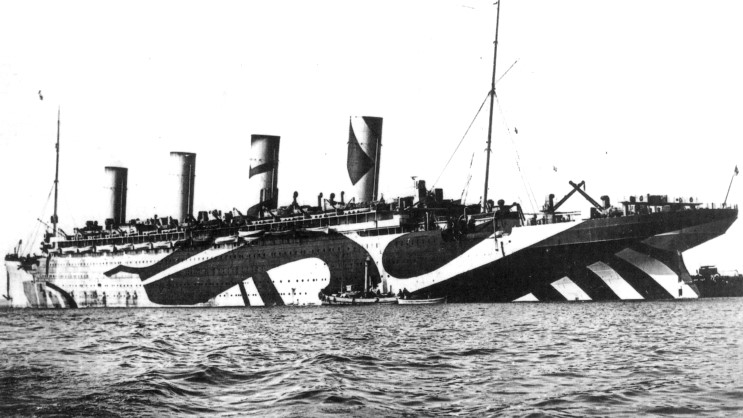
After this transaction she was intended to be laid up until the war ended, but the Government required her services, as a fast troop transport. She was stripped of all her luxurious fittings, and had the famous 'dazzle paint' job.
She could carry up to 7,000 troops at one time.
The Olympic served proudly through the whole war, rescuing ships crews in distress, and she topped it all by being the attacker, instead of being on the run. During her 22nd troop carrying run the crew spotted a German submarine, the Captain ordered the ship to be turned around in order to ram the submarine, by the time the German crew knew what was happening it was to late, the Olympic tore a whole through the hull of the sub, some of the crew were rescued by a destroyer that was at hand.
The hard earned nick-name "old reliable" was soon put in place by the Captain, crew, and all who sailed on her.
In 1918 she again returned to Belfast too be fitted out to carry passengers again. she was converted to run on oil instead of coal, and this meant that she would need 300 less crew, she would be more efficient this way too. After 2.5 million to the White Star Line she returned to passenger traffic, and was loved, admired, and adored by all.
By 1933 sea travel diminished tremendously, due to several different reasons. The White Star Line, and the Cunard merged together in the early 1930's and began to sell off some of their ships, the Olympic's future seemed doubtful, after all she was 25 years old at this time.
By 1935 her time was up. They tried to sell her, but nobody wanted her, so she was stripped of her fittings, and superstructure, and the rest was sold for scrap.
I guess that's what happens to everything sooner or later, it is just kind of sad to me. She was built at the height of shipping engineering, she was a loved ship by everyone, she served well, and worked hard, and then was sold for scrap! She was built first out of the class, and survived the longest out of the Olympic class. There is just something eerie about that picture above to me.
Since we all know what happened to the Titanic, I'll be posting something on the sister ship Britannic. She as well had an interesting, and short life.

Thursday, May 31, 2007

Second Officer, Charles Herbert Lightoller

{"What I remember about that night, what I will remember as long as I live, is the people crying out to each other as the stern began to plunge down. I heard people crying, 'I love you.'"}
Lightoller was very much the image of a steamship officer. Tall, sun bronzed and handsome, with a deep, pleasant speaking voice. He was a good officer and an outstanding seaman.
His monthly salary was 14.00.00 [in English pounds.]
At the time of the disaster he was 38.
His berth place was Chorley, Lancashire England.
His residence in 1912 was Southampton, England.
He began his career in 1900 with the White Star Line working with a man called E.J. Smith whom he liked and admired very much.
He was born in March 30th, 1874. His mother died only one month after he was born. Within one year one of his sisters died, and his father cared him for. The strain must have been too much on him, so one day he just upped and left for the sea.

“It is difficult to convey any idea of the size of ship like Titanic, when you could actually walk miles along decks and passages, covering different ground all the time. I was thoroughly familiar with pretty well every type of ship afloat, from a battleship to a barge, “but it took me 14 days before I could with any confidence find my way from one end of the ship to another by the shortest route.”
When he left his wife and home in Southampton, he told her “don’t you bother, the sea isn’t wet enough to drown me.” Second officer Charles Herbert Lightoller did survive the Titanic’s sinking.

I feel another quiz coming on!!!

Monday, May 21, 2007

Titanic's Funnels, or Smokestacks

Now you may say, hmm... what is there to say about the Titanic's funnels? Well there is a little bit to say.......
The first time the Titanic's funnels became an issue was when Bruce Ismay was inspecting a model of the ship, before he signed the contract to have them built. He asked again how many engines the Titanic would have, thinking that maybe he hadn't heard right, three was the reply. Then why four funnels, he inquired? The reply was plain and straight to the point, the Mauritania, and Lusitania, both have four funnels, we didn't think that you would want your ship to have less. Besides it will make the ship look more powerful. With third class passengers of the time, they thought that the more funnels the ship had the faster it would go, and a ship this big would look out of place with only three funnels.
The Titanic's funnels were constructed away from the site and then transported to the fitting out wharf for installation.
They weighed 60 tons apiece and they were big enough to drive two locomotives through at the same time.


I think that the Titanic's funnels really made the Titanic stand out among other ships. It gave the ship a majestic look, as it was truly Queen of the seas.


Once they were fitted out, they were cabled down to the decks by guy wires. The fourth funnel was just a dummy and was used to vent the engine room and kitchen galleys. They were painted bronze at the bottom and a black buff at the top, typical of the White Star Line.
The funnels only had a few days to glory in the bright sunlight. I have looked for the fate of them, but I have not really come up with anything. They are somewhere...... perhaps rust eaten, and almost gone now, but they were once the crowning glory of what has be come the most famous shipwreck of all time.

Thursday, May 10, 2007

Titanic's Construction

This is a long post, so grab a cup coffee, a donut, and a big fuzzy blanket and cuddle down!
You better make that two donuts...

In 1907, a limousine pulled up in front of a mansion. A man of medium height, with a dark mustache steps out of the car. He walked quickly up the stone path, and up the steps too the entrance. As he enters, the butler quickly removes his long overcoat, and top hat. This man’s name is John Bruce Ismay; he is the president of the White Star Line.

John Pilkington, and Henry Threlfall Wilson formed the White Star Line in 1845. All of the White Star Line’s business was conducted in Liverpool, England. This Shipping Line was started mainly to be involved in the Australian gold rush. The White Star Line Shipping Company used charted sailing ships from the time the company came into existence. Not until 1863 did the White Star Line acquire a steamer. After the fall of the Australian gold rush, the White Star Line concentrated on the shipping route between Liverpool and New York. In 1867, they invested heavily in new steamers, and at that time the Royal Bank of Liverpool failed. This disaster left the company bankrupt, with the outstanding debt of $527,000.00, and no way to pay it back. Thomas Ismay was the president of the White Star Line at this time [Bruce Ismay’s father] and came into contact with men by the name of Gustavus C. Schaube, and Gustav Wolff. If Thomas Ismay would agree to have Gustav Wolff [Harland & Wolff ship-builders] build his ships, Wolff’s uncle Schaube, would finance the ship-line. Thomas agreed, and a new partnership was formed between the White Star Line shipping company, and the Harland & Wolff, ship-builders. The agreement was this, H&W would build ships at cost, plus a fixed percentage, and they would not build ships for White Star Line’s rivals. So, on July 30th, 1869 the first orders were arranged with H&W. It was to be a new class of liners, the oceanic class. There would be four ships in this class, the Oceanic, Atlantic, Baltic, and Republic, and by 1871 the shipping company was on route again between New York and Liverpool.
Through the next years, the White Star Line would abound in profits. The shipping company also acquired new ships such as the Germanic, Teutonic, Majestic, Celtic, Cedric, Baltic, and Adriatic, all of these built in between 1875 and 1907. The Teutonic won the Blue Ribbon for being the fastest ship on the seas at the time.
In 1902 the International Mercantile Marine [IMM] took over many ship-lines, and Bruce Ismay wanted no part of it. But! He could not compete with it, so he joined it. So, by 1903 the White Star Line was part of a large American conglomerate, owned and directed by John Pierpont Morgan.
As John Bruce Ismay entered Lord Pierre’s home, he had something on his mind, something very serious. After formal greetings were made all around, Ismay was shown into the dining room. Ismay and Pierre had a long friendship, not just as partners in the struggle to be the best shipping-line and ship-builders, it was deeper than that, they had a true friendship that went beyond the expectations of the shipping world. After the elaborate dinner and dessert, they set around a small table discussing many different things that had been going on. It was then, when they were sitting there smoking cigars and drinking hot tea, that one of the most important discussions of the age took place. Sooner or later shipping came up; there was a major problem.
The Cunard Line, the rival shipping company had built two ships like the w
orld had never seen. Not in size, or luxury, or beauty like the others, but in speed. These new liners, the Lusitania, and Mauritania, had set new speed records, they were faster than any other cruise ship in the world at the time. Pierre and Ismay were not concerned about speed, but these new ships were cutting into their profits. The White Star Line didn’t have a ship to challenge these new queens. Ismay begin to sketch something on a piece of paper, things were running through Ismay’s mind, a new ship! That’s what we need to compete with the Cunard Liners! It would have to be a ship of grand scale, something like the world had never seen, something that would put the Cunard shipping line back in their seats. Something that would overcome the elements, something that would attract the paying eye, something….something…… We will build a ship that has more luxuries than any other ship, we will build a ship that is indestructible, and we will build a ship like the world has ever seen. That was definitely the answer! A new class of ships! But what will this cost people, it was simple, the same fixed rate. Which was cost +10%, something everybody could afford, from first class, to third class. This would not be unusual for the White Star Line. They had been more concerned with luxury more than speed for the last several years. On the other hand the Cunard Line was definitely more concerned with speed. Ismay didn’t want to compete with the speed of these new ships, he would lose. This was a battle that neither party could afford to lose.As the evening drew on, Ismay took his leave. Back at his house, he must have been more excited than words could tell, it wasn’t every day you get to build and own the biggest ship in the world!

As days grew into weeks, blue prints and plans were being made on a major scale. Finally, the H&W designers brought a small model of the new class of ships for Ismay to inspect. Ismay did not show his emotions as he viewed the ship with satisfaction. The head designer at H&W must have been shaking slightly as the president of the White Star Line inspected the design of the ship. Finally as Ismay stood up from crouching over the model, he said, “I think it’s fabulous!” The ship designer let out a sigh of relief.
This class of liners would need to have names that would fit the
m properly. Until this moment they were known as ships 400, 401 and 402. The first to be named, was Olympic, after the Greeks. Such a name sounded fitting for such a ship! What would they call ship 401, the second in the group of three? What about the mighty Titans, rivals of the Olympians in the early days, surely this ship must be named TITANIC! Ship 402 would have a simple name, but fitting never the less, Gigantic. On July 31, 1908, the order was put in at H&W for the new class of ships, R.M.S Olympic, and Titanic. Gigantic was ordered after Titanic and Olympic’s launch. As John Bruce Ismay signed the contract with Harland & Wolff, these ships would be built no matter what happened. When Ismay put his pen to the contract, he had untold joy in his heart, finally these new ships were becoming a reality. For over a year he had dreamed of this moment.The Belfast work force gasped!In the history of shipbuilding had there been a ship of such proportions, never before had man built a ship like the Titanic. Until now, the Cunard liners Lusitanian and Mauritania had been the largest ships in the world. The men of H & W were invited to build not only one, but three ships much bigger than the Cunard liners. These new ships would be 90 feet longer, 4 feet wider, and 15,000 tons heavier. The Titanic would be a massive ship, nothing like the world had ever seen, she would be 883 feet and 9 inches long, and 92 feet wide. This leviathan would displace 60,000 tons; the empty hull alone would weigh 26,000 tons.

From the top of the funnels to the keel would be 175 feet tall, 35 feet of that would be under the water line. Also the Titanic was taller above the water than most urban buildings of the time.
Titanic altogether had four funnels-which were constructed at another site from H & W, and then transported to the H & W
for placement on the ship, they weighed 60 tons apiece and were big enough to drive two locomotives through at the same time. The fourth one was a dummy added mainly to vent the engine rooms and the galleys, but it also made the ship look more powerful, third class passengers especially thought the more funnels the ship had the faster it would go.
When finally built, the Titanic would be the biggest man made obje
ct ever moved until the 1920’s!
Titanic would have three massive propellers, two three bladed o
nes that were 23 feet and 6 inches tall, and a smaller four bladed propeller that would be 16 feet and 6 inches tall.
The Titanic had 24 double-ended boilers and 5 single ended boilers that would be placed in 6 boiler rooms, the double-ended boilers would be 20 feet long and 15 fe
et and 6 inches high, the single ended boilers were 11 feet long and 9 inches. Altogether she would have 159 furnaces. Once on the sea, she would use 850 tons of coal each day.
She had two reciprocating, four cylinder, triple expansion, direct acting inverted engines: creating 30,000 horse power, the left over steam would go to a third engine, a low pressure Parsons turbine: creating 16,000 horse pow
er, this engine could not be put into reverse. Added all together would generate 46,000 hp. This would not make a fast ship, but the White Star Line was concerned with elegance and luxury, more than speed. These engines would drive the ship through the water at more than 23 knots at top speed, which is not too bad considering that the ship weighed 60,000 tons.
The Titanic had a rudder that weighed 100 tons, and the Titanic’s center anchor weighed 15 tons and was as tall as a house. Each chain link was as tall as a man and weighed 100 pounds.
Before construction could begin on these new ships, H & W had to
update their piers, gantry’s, and slipways.
The Titanic and Olympic we
re built side by side although Olympic was started a few months before Titanic.
The keel was laid down on March 31, 1909. During construction timber props were used to hold
her up.
14,000 men worked on Tita
nic, being the highest employ rate H & W had ever had. If you happened to be late to work once the shipyard gates were closed, there was no way to get in, you just lost a whole day’s pay.
Over the course of the constructi
on, 17 men lost their lives due to the unsafe working conditions. One of the losses was a 15-year-old boy.
In order to lower the massive engines in place, H & W had to order special floating cranes from Germany that could lift 200 tons to set the engines and boilers down into the ship. This cost $30,000 to the H & W Company. The engines set on their own weight just like the boilers and t
he huge funnels. The funnels had cables running down to the deck to help hold them in place in case of rough seas.
The Titanic was also supposed to be the symbol of modern technology, not in just the size of the ship but in safety too. To live up
to the high standards she had a double bottom, a double hull of 1 inch steel plates that were 3 feet wide and 16 feet long, each piece weighed 3 tons, 3,000,000 rivets were used to hold the ship together, and a new design of 16 watertight compartments with watertight doors that could be closed from the bridge or by automatic electric sensors. This is when the newspapers started to call her unsinkable, a term that quickly flourished in the minds of the designer and J. Bruce Ismay. Soon the world started saying…. “This ship is unsinkable” and the term “no, not even God could sink this ship” came about. That is what this ship would be known for, Sadly, as everyone would come to find out, there was a terrible flaw; these watertight bulkheads only went up to E deck. The ship could only float if any four or five of her compartments filled with water. But none could think of a disaster that would cause more than four of her compartments to fill up, but which means that this ship was not unsinkable if there was the possibility of that danger.
A man by the name of Andrew Carlyle had been chief designer of the Titanic until the issue of how many lifeboats were necessary came up. The British Board Of Regulations was out of date. It stated that a ship of 10,000 tons must have at least 16 lifeboats, but these new ships were five times that big and Carlyle new it. The Titanic was designed to carry
3500 passengers and crew, fully loaded. Which means these new ships would need 64 lifeboats to cover every one board. Carlyle argued these points with Lord Pirrie, and J. B. Ismay. “ These new ships must carry enough lifeboats for every one on board.” Said Carlyle, then Pirrie stated, “The Titanic is its own lifeboat” ‘and having 64 lifeboats festooning the deck of the ship would scare people away”. He argued that this ship was made with the latest advances in safety technology and most of all “you designed her.” Carlyle was getting flustered with Pirrie and said, “don’t you see anything that is designed by man is liable to destruction.” Then Pirrie clearly told him that these ships would meet the requirements of the BBOR, only having 16 lifeboats, and four collapsibles. Then Andrew Carlyle, after being in the family business his whole life, walked out for good. He was not going to design a ship that would not have enough lifeboats for all the passengers and crew.
After he left, H & W needed a new chief designer, so they called on Thom
as Andrews, [he had actually helped design the Titanic with Carlyle] to pick up were Andrew Carlyle left off. They chose Andrews to keep this operation in the family business. [Andrews was Pirrie’s nephew!!!]
With the main structure of the ship completed, launching
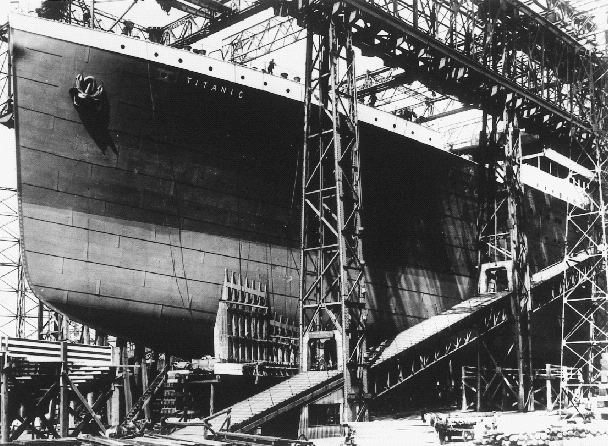
of the Titanic was set for May 31st, 1911. For the occasion 100,000 people turned out. There was no christening of the Titanic, White Star Line and H & W did not take part of that tradition. So, at 12:13 the hydraulic triggers were pulled and the largest man made object moved for the first time, slid down the slipway on 22 tons of tallow and fat, and other types of grease, and of course her own weight. The Titanic reached a speed of 12 knots and was brought to a halt by anchor chains and cable drag chains. The whole process took 62 seconds. As one worker put it after watching the ordeal, “they just builds’em and shoves’em in.”
The Titanic was towed to the H & W fitting out wharf, from installing passenger accommodations, to engineering equipment, and just mainly making her seaworthy.
Carpenters, carpet layers, steamfitters, metalworkers, and electricians [just to name a few of the trades used] all had a chance to show their handy work.

Specifications to the Titanic were going to be based upon those of the Olympic. There would be some changes made, and as a result, the Titanic would be a thousa
nd tons heavier than the Olympic, and even more luxurious. One of these changes would be to close the 1st class promenade deck in by glass. Passengers had complained about being splashed with spray from the sea. This change made a notable difference between the two ships.In the next months to follow, the empty hull of the Titanic would be formed into the most elegant, and luxurious ship the world had ever seen sailing the sea.

Monday, May 7, 2007

Sea Trials

The Titanic’s sea-trials were to commence on April 1st, 1912 at 10:00 am, but strong winds delayed it until the next day. The ship’s officers had spent a few days in Belfast making sure that everything was going to be ready for the sea-trials.

A coal strike had taken place a few months earlier, which means there was a shortage of coal. So in order for the Titanic to undertake her maiden voyage, the White Star Line had coal brought from other ships and canceled their routes. They moved passengers from those steamers to the Titanic at no extra cost.
The Titanic used a vast amount of coal every day, 850 tons to be exact.
So on April 2nd the Titanic’s sea-trails began, for the first time at Captain’s orders, the Titanic was put at full speed, and for the first time the ship’s system came to life and started to pound. The crew was eager to see what the Titanic was capable of. First she was to drift to a stop, then at 20 knots, the order for full speed astern was requested, it took her 850 yards to come to a complete stop. After that, various maneuvers were conducted to see and test what she was capable of. At top speed she reached 24.5 knots, more than her planned 21 knots. At full speed she made a circle in 3,850 feet diameter. The Titanic’s sea-trials lasted only 6 hours, same as the Olympics, and passed with flying colors. So with the official papers signed, stating that she met the requirements for the British Board Of Regulations, “making her good for one year” it allowed her to carry passengers, and to take on the endless sea.
So with sea trials quickly over, the Titanic sailed at midnight to Southampton where her maiden voyage would begin 8 days later.
The Titanic doesn’t just represent the skills and labor of men, but their hopes and dreams.
So now, the greatest ocean liner the world had ever seen, with the best crew and officers the world practically had to offer, would depart Southampton bound for New York, but would never make it. In just a matter of days the most famous shipwreck of all time was about to take place. Sometimes I wonder if Sea Trials were as strict as they should have been, considering how big these new class of ships were.

Monday, April 16, 2007

April 14, 1912 Sunday night.... part 2

....Once the passengers were mostly in bed,

Came the dreadful cry “iceberg dead ahead.”

They then didn’t know it

But soon found out,

She would not make it there was no doubt.

The pain was unbearable that fateful night,

For the Captain and crew their lips they did bite.

One minute she sailed

Next minute she stopped

Hit by an iceberg that wrenched her apart.....

Captain Smith no doubt was stricken in heart, as he called all of the officers to the bridge to let them in on the situation. He and Andrews knew that there were not enough lifeboats for all of the passengers on board.
He shared the disastrous news with the officers, and gave them the following orders; first officer Murdoch, and third officer Pittman were ordered to use their men to rouse the passengers, and get them on the boat deck with their lifebelts on. Second officer Lightoller was to use the seaman to uncover, and get the lifeboats ready to launch. The fifth and sixth officers were to stay on the bridge, and fourth officer Boxhall was to work out their position.
At 12:10am Monday morning the Titanic position was given to the wireless operators, 41*46* N, 50*14* W. At 12:15am the first CQD distress call was sent out.
As passengers were being roused in the early hours of the 15th, most of them were not happy campers, what was this? Here these passengers had booked on an 'unsinkable' ship, and now they are being woke up, under the pretence that the Captain is being fussy, and correct, making them dawn their lifebelts, dress warmly, and go up to the boat deck, where the weather was now freezing. Put yourself in their spot, you're sound asleep, and then a steward appears at your door and tells you that you have to be prepared to abandon ship! This would have been a very hard task to accomplish, and reasonably so. They are on a "unsinkable" ship!!! Part of the reason for their stubbornness is, the passengers did not know the real state of the ship, and thought the Captain, and officers were just being picky and cautious about things.
The crew in the bottom of the ship were told to stay at their posts, and keep fire in the boilers, to power the generaters, to give power to the wireless, and keep the ship brightly lit. These men are not really talked about, when honors are being passed out, but think about it, these men were in the lowest part of the ship, not the place you want to be when a ship is sinking, these men knew that they did not have a chance. If they would not have stayed at their posts, the Titanic would have blacked out, the wireless radio would have had no power, and nobody would know what even happened to the 'Queen of the seas.' Truly these men were brave! Then think of the wireless operators, here they are swamped with private 'stuff' and now their stopped in the middle of the Atlantic, with damage to the ship. What if they had to turn around and had to return to Belfast, to repair damage. If that happened they would not get a moments rest.
Third class passengers were told to stay below decks, until further notice! First and second class were slowly meandering their way to boat deck, and to first class lounges, and smoking rooms.
Captain John Edward Smith could not put off the inevitable any longer, he ordered women and children into the lifeboats. At this time there is no panic, passengers are not even concerned at this point about the safety of the ship. Women did not really care to leave the brightly lit decks of the Titanic, to enter a small swaying lifeboat, and second of all their husbands could not come along. At first it was hard to convince women to leave the Titanic, but after a while a few here and there were starting to get in.
Officers were becoming aware of the fact that the Titanic would really sink. At 12:45am they fired off the first distress rocket.
The Titanic was beginning to list to starboard, and water was rushing into the forward compartments.
Right now things are calm and peaceful, men step back and light cigars and start smoking calmly, and talking quietly. Also as time went on, more and more passengers were getting into the lifeboats, maybe they were realizing that something was wrong. This is one of the times I just have to ponder the things that were going on, what were the passengers really thinking? How did they fill? Everybody in this age was concrete in the fact that the Titanic, and her sister ships were unsinkable, but I have to wonder if some unknown feeling were beginning to chip away at that firm belief.
There was one mistake that stands out of them all in my mind, one lifeboat was capable of holding 70 to 74 people, but many were sent out half filled or less than half, one was sent out with 12 passengers, when it was capable of holding 70!

If all of the lifeboats would have been filled to their full capacity 500 more souls could have been saved.

The Titanic could see a ship in the distance, but she was not responding to the distress calls, so Smith thought that rockets would make them aware of the peril that they were facing. That ship was the Californian, and the officers on deck did see the rockets and reported to the sleeping Captain of what they saw, they were wondering why a big ship like that would fire rockets. The Captain said they were probably company rockets, and to enter it into the log, none thought to wake the sleeping wireless operator. So, the Californian set through the whole night 10 miles away and watch the sinking Titanic fire rockets.

Back in the Titanic's wireless room the operators could not find anybody closes enough to help, they were able to contact ships 75 to 200 miles away but that would be no help. Bride suggested to Phillips in a joking tone, "you might send SOS it could be the last chance you have to send it." It was the first time that SOS was internationally used!

Down it third class it was utter pandemonium, the crew received orders that only women and children were allowed up top, but a lot of them didn't understand what they were trying to tell them, and they did not want to be separated from their husbands. It was complete chaos!
There were many calm men that fateful night, but the coolest men on board were Captain Smith, and Major Archibald Butts, the military aid to president Taft. There was a time when three third class men came charging up to get into a lifeboat, yelling screaming, and fighting when officers told them to step back or they would be shot, Butts covered them with a 38 revolver. First class passenger Mrs. Henry B Harris said "the world should raise in praise of Major Butt. That man's conduct will remain in my memory forever. The American Army is honored by him." There was no fear in his manner, even though the circumstances called for it. There was one time when a dozen of women became hysterical all at once, Major Butts stepped over to them and said, "really, you must not act like that." His calm assurance helped many that fateful night. A man saw a boat being lowered and ran to jump in it, but Butts shot him in the arm, caught him in the back of the neck, and jerked him back like a pillow, and cracked his head against a rail, and said, "sorry, but women and children will be attended to first, or I'll break every bone in your body." Many people were heard that night to say, "thank God for Major Butt." Again he saw a man trying to get in to a lifeboat, but he caught him and said, "keep your head and be a man." He helped so many people that night with such a strong firmness and sincerity, he was an example to every man on board that fateful night. His last known words are thought to be when he was helping a women into a lifeboat, preforming small courtesies, and smiling as if death were far away, instead of just a few moments from it. After lowering the lady into the lifeboat, he said, "good-by miss Young, good luck to you, and don't forget to remember me to the folks back home." He stepped back and waved his hand!

Arms and ammunition were being passed out among the officers, Smith knew it was a matter of time before some men tried and made for the lifeboats, but they were going to enforce the rule, "women and children first." On the port side of the ship second officer Lightoller was filling lifeboats, and it was becoming increasingly harder to keep men from going to the boats, but Lightoller was upholding the rule 'women and children first' strictly. On the starboard side it was Murdoch filling lifeboats, he was not as concerned as Lightoller about women and children only, if there were no ladies about he would allow men to get in.

“Women and children” was the cry,

Get them away

With no delay.

The bravery of men

Abounded that night,

Standing aside that others might live,

Staring at death

Like brave men they did.

Oh grave where is thy victory?

Oh death where is thy sting!

As their loved ones departed

Too see them no more,

The only thing left, was a door.

The door of eternity open wide,

To receive these men as they died.

“Nearer My God To Thee” was heard that night,

Upon the waves of untold fright.

Some men however were panic stricken, and six men sreaming in terror dashed for the lifeboats, and six shots sounded out in quick sussesion, and six men were stopped in their tracks, this helped discouraged violations of the rule "Women and children first." But on the whole most of the men were the brave type, telling their wives that they would meet them on another ship, knowing good and well that would not be the case.

Back in the wireless room the operators had found a ship close enough to help, the Carpathia! She was 48 miles away, and was coming at full speed and would be there in four hours, the Titanic only had one hour to live.

There are many differant versions of how Captain Smith met his death, I'll tell you the one I believe; first of all he had to be in utter dispair, on his last voyage having a perfect record at sea, his ship was sinking, over 2,000 passengers that should be in bed right now, are now on the verge of death, you know that, that morning they were not expecting to die. Was it Smith's fault? NO! It was not his fault, but he was responsible, you can't blame the accident on him, he wasn't on the bridge at the time of impact, but as Captain he was responsible! He was last seen heading to the bridge, the place he made his life out of, the place he had commanded for forty years, the bridge. I speculate that he stood at the ship's wheel as the cold waters of the icy Atlantic, swirled around his feet then up to his chest, and finally to his nostrils, and there he died, at the ship's wheel!

After all the lifeboats on the starboard side had been lowered, first officer Murdoch took the revolver out of his pocket and said "try and save yourself, good-by and good luck." With that he shot himself through the head and ended his life!

Up to this time there had been no real panic, but now it was sure that the Titanic would sink. Stokers came up from below, their posts now submergerd and they beat all down in their path, for they had iron bar.
The ship now is at a steep slant!
Sences of the sinking vessal become more tragic, as passengers faced the certain fear of death. Many women rejected the lifeboats to stay and die with the men that they truly loved.

As the bow slipped beneath the waves, and water crept up around the bridge, and started to surround the first funnel. The first funnel {smokstack} weighing in at sixty tons of steel could no longer take the slanted strain, the cables holding her whipped back into the water like angry hornets, and no doubt killing those in its path. Then the massive funnel fell over and killed those in the water around her!

Back in the wireless room, news came that the Carpathia was making full steam, and was racing to the sence at full blast. Jack Phillips must have wondered where the fool was that blasted into his ears a while back about some ice-warning, the power was strong, he must be in the vicinity. Now he probably wished he would not have been so rude!
Not long after that the power left the ship's wireless room, but Phillips was still tapping away, even though it did no good.

Benjamin Guggenheim also showed great courage in the face of death, he, being one of the richest men in the world, faced death like a man. When someone asked him if he would try to save himself he said, “I think there is grave doubt that the men will get off safely. I am willing to remain and play the man’s game, if there are enough boats for more than the woman and children. I won’t die here like a beast. I’ll meet my end as a man.’ He paused for a moment than continued, ‘tell my wife, Johnson, if it should happen that my secretary and I both go down and you are saved, tell her I played the game out straight and to the end. No woman shall be left aboard this ship because Ben Guggenheim was a coward. ‘Tell her my last thoughts will be of her and our girls, but that my duty now is to these unfortunate woman and children on this ship. Tell her I will meet whatever fate is in store for me, knowing she will approve of what I do.” He was last seen talking to Major Butts and Colonel Astor.

Thomas Andrew the designer of the Titanic, the first to know that she would not make it, was last seen in the first class reception room, he had a wife and three children.
There is an unknown man that gave the men on board a bad name, instead of staying with the men and letting women and children get into the boats, he went back to his cabin and put on woman’s dress, woman’s shoes, a woman’s hat, and a woman’s veil, went and walked back through the heroic men standing their waiting to meet their death, and got on a boat and saved himself, not a more cowardly thing could have been done.
Among the cowardly few men who got onto lifeboats, none other but John Bruce Ismay the president of the White Star Line stepped into a lifeboat. He, above all other men should have stayed on board, since it was he who argued with Carlyle about the issue of lifeboats, and said the Titanic is unsinkable, it’s its own lifeboat, and made the decision that there would not be enough lifeboats for every one. He should have been the last man to be put safely in a lifeboat. But he was scared of death and could not stay on the Titanic’s sloping deck. He died years later almost bankrupt.

As the ship began to settle to the starboard side at nearly a 45-degree angle, more and more people began to jump. It must have been a hard thing for the ladies who set in the lifeboats and watched their husbands smiling calmly at them, awaiting their death.

Among the heroes, the Titanic’s band was one of them, Wallace Hartley being the bandleader. As the ship neared the end the band started playing the beloved hymn “Nearer My God To Thee”. Some say they played this until the water was about their knees, but that would have been nearly impossible, because of the angle of the ship. But I believe that they played until they could no longer keep balance. Many times when you think of the Titanic sinking you think of Nearer My God To Thee, but don’t give honor to the men who played it to the very end. This song would also cause men to reflect on the fact that the end was very near. The band’s heroic deed went down in the history of the Titanic.

Passengers in the lifeboats could hear the sinking ship now, as she began to aquire a very steep angle, everything inside the ship began crashing over, plates, tables, beds, tea cups, luggage, machinery, and sounds of terror, etc...

Then it happened. The Titanic was in her death throws, she started to make her last plunge, as water started to creep up the deck even faster, people began to jump and clamber for the stern area. The Titanic was almost standing upright in the water when between the third and fourth funnels the biggest ship in the world broke apart. She could no longer take the heavy strain, and then the lights flicked and went out for good. Imagine the fear in the passengers not all the way up to the stern of the ship yet, and to feel the deck begin to break, and the wood planks pop apart below their feet then to fall to your death inside the broken ship. The bow plunged to the bottom of the ocean 2 ½ miles below. The stern area came crashing down into the water; it created a small tidal wave, and no doubt killing people that would have been in her way. People clung to the stern as well as they could, knowing the end was finally here. As the stern sank lower and lower, the water crept closer and closer. Then she plunged and sank. The R.M.S Titanic was last seen at 2:30, on April 15th 1912. The world’s greatest liner was gone, everything was gone.

It was the end of an era!

...Titanic plunged with a moan,

She died with a great groan.

Behind her she left hundreds of souls

Where cold would soon take its toll.

Titanic was gone

As soon as she came.

She lost her glory,

But gained great fame.


James Daniel McEntire